Tuesday, December 9, 2008

Have SMS, Will Operate :)

I thought I had read everything involving mobile phones and global health applications. We've covered cell phones as surgical lights, as health information companions, diagnostic and compliance platforms, etc.

I've never come across the cell phone as a surgical coaching aide. That the experience of Dr. David Nott from Médecins Sans Frontières during a risky life-saving arm amputation of a Congolese boy. Thanks for quick thinking (and thumbs) Dr. Nott received step-by-step instructions from his friend Professor Meirion Thomas back in London via SMS on how to perform a forequarter amputation.

The BBC interviews Dr. Nott:

Hat tip to Medgadget

Monday, December 8, 2008

Swiping for Health: Utah Researchers unveil diagnostic possibilities

Scientists Marc Porter and Michael Granger from the University of Utah have devised a method that takes advantage of a phenomenon known as giant magnetoresistance (GMR) to detect various disease markers. GMR is a Nobel prize winning discovery that has been known for 20 years:
Magnetoresistance is the change in a material's resistance to electrical current when an external magnetic field is applied to the material. That change usually is not more than 1 percent. But some multilayer materials display a change in resistance of as much as 80 percent. That is giant magnetoresistance.

Porter and Granger created a prototype reader that uses this phenomenon to detected changes in GMR caused by the presence of spots along the sensor. By swiping the sensor along the GMR reader, the sequence of spots (arguably the presence of some pathogen) creates a unique signature that gets interpreted as a diagnostic identifier. The device is currently PC sized but the team is working on miniaturizing the components for portability.

This is a pretty interesting approach to diagnostics and I wonder if it offers an alternative to the advances of lap on a chip technology, or if will become another form of diagnostic vacuum tubes.

More at Eureka Alert

Little Devices in the Wind: Part II


Some time ago we featured a series of mini wind turbines by a group of researchers in Hong Kong. A great follow up is the Febot which combines a single AA-battery socket with a mini turbine to make a single charging station that sticks on the side of a window. They should make a version that can stick to your bike handlebars.


More at Yanko Design

Malaria Vaccine Launched

The Bill and Melinda Gates Foundation funded the development of a series of vaccine candidates against Malaria. The results are coming in from Burkina Faso, Gabon, Ghana, Kenya, Malawi, Mozambique, and Tanzania and they show that one candidates to be 30 to 50% effective. That may be a little too low to make a huge impact. The investment seems to be paying off in a step in the right direction though.

More at Foreign Policy

The History and Science of LEDs


The Appropriate technology gurus at AIDG have a wonderful collection of LED videos that shows the history behind the ubiquitous light source, and a series of tutorials on a DIY LED. Sounds like a weekend project.

More at AIDG

Sunday, November 9, 2008

3D Printing from Paper and Glue: The Mcor Matrix 3D printer

File under: Christmas wishlist


According to Engadget, UK company Mcor has cranked out an affordable attempt at 3D printing that uses A4 paper and glue to produce rapid prototypes. I had to read this several times, but they use regular paper which gets cut up into bits and then glued to produce the results above. I'll say this is going to be invaluable for our HLab network real soon. The machines are expected to hit the States in 2009.

Their take:
We wouldn't go so far as to say that 3D printers are growing tired, but we are growing short on patience waiting for a commercial version that the average joe / jane can afford. Thankfully, Mcor is up to the challenge, recently delivering its Matrix to the UK and gearing up to bring it to other parts of the world in 2009. Put simply, this carving creature uses traditional A4 paper and PVA glue to create objects like the ones you see above. Throw in a nice, sharp blade and a little bit of computational prowess, and you've got yourself one wicked 3D printer with running costs "up to 40 times less" than competitors.


Thanks to Engadget

Saturday, November 1, 2008

What we've been up to


We're back everyone. After a long stretch of work that included some exciting and blog worthy moments, I've finally caught up with my RSS reader and Blogger to bring you more consistent posts.

We have been simply too busy to blog, which is a shame, because it's been the "good busy" type of busy. We've been awash with devices and great people who are more interested than ever in the convergence of medical technology and international development. That means more LTDC posts than ever in the coming weeks. While this is certainly not an IIH blog, I might as well explain what IIH (and by extension myself) have been up to.

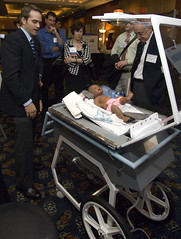
Last week, CIMIT held their annual Innovation Congress which featured an Exploratorium which prominently featured global health medical technologies by the CIMIT Global Health Initiative spearheaded by Dr. Kris Olson and his crack team of innovation specialists [shown at left demonstrating their car parts incubator], as well as IIH technologies (thanks CIMIT!) working under the same tent (or thatch roof...)

We pulled allnighters trying to get newer prototypes delivered, last minute machining, and 3 am diagnostic reactions to make a good showing at the event. By listening to the crowd, it seems our team achieved that.


The week before CIMIT, we were invited to participate in the last session of MIT's Center for Biomedical Innovation's "Critical Elements of a "Learning Healthcare System" workshop, which featured a poster session on global health. We saw our friends at X Prize, M-Lab (MIT's Mobility Lab which designs mobility solutions for the developing world), the BAMM lab's CD4 microfluidic technology, and the other IIH, Innovators in Health which invented the uBox and uPhone telemedical systems for tuberculosis compliance.

Throughout this time, we were delivered the news that Interamerican Bank for Development is going to support us to bolster our collaboration with our Nicaraguan partners, CIES (Centro de Investigaciones y Estudios de la Salud) and CARE Nicaragua. The support will accelerate our collaboration with this dynamic organizational duo by deploying a set of field ready biomedical learning kits that will allow Nicaraguan innovators to come up with their own medical technology innovations. Check out the Scidev scoop here.

Beyond all this, we owe you updates on Joost Bonsen's Development Ventures and their great line up of startups to tackle the Millenium Challenges, my field notes from the upcoming Duke conference on Bioengineering Global Health, and another round of devices from the CIMIT event.

Sunday, October 19, 2008

Seen and Heard


Another cool conference (or unconference) that I am missing: the first Open Sustainability Network unconference. Appropedia's Lonny Grafman told me about it and I'm sure they've come up with some great stuff over the last two days.

Technology, Health and Development Blog has a great article on the future of M-money.

Wired has a great wiki on how to take microscopic photos using a digital camera.

According to the PSD Blog, Gartner has some ideas on the future of microinsurance, the scheme that aims to create a new insurance segment at affordable prices. We may finally be able to get a reimbursement code for those agricultural prosthetics.

Congrats to Amy Smith on Winning Popular Mechanics Breakthough Award!

Popular Mechanics just awarded MIT's own Amy Smith with a Breakthrough Award for her pioneering work in bringing technology to developing countries.

The Secret Life Bees: Diagnostics


Artist Susana Soares is creating a series of beautiflly crafted chambers that collect air samples, or breath samples. Her BEE'S project builds on bee's acute odor perception.  In my book, these a wonderful example of good elegant design that can have wonderful apps in the developing world. No electronic noses, or fancy micromechanical systems, or complex diagnostic arrays: just a handful of dutiful bees trained to be attracted to something which produces a yes/no response. 

Another company is working on using the bees as portable explosives detectors.

This reminds of a previous project funded by the World Bank to use trained rats to smell and detect TB in samples. I like the Soares approach more though, after all, no one's put a rat on a cereal box design yet.

More at Proto

Sunday, September 28, 2008

CIMIT Innovation Congress 2008


Dates: October 28-29, 2008
Location: Back Bay Events Center, 200 Berkeley Street
Boston, MA

CIMIT, which stands for Center for Integration of Medicine & Innovative Technology, is a unique consortium of hospitals and research labs in the Boston area. It is holding it's annual Innovation Congress which will include their Exploratorium featuring a dedicated section to Global Health. If you are in the Boston area, watch for IIH and LTDC innovations in the area including the XoutTB System, an incubator for the developing world by team led by Dr. Kris Olson, ClickDiagnostics, and several other devices and the innovators behind them.

Be sure to register early at
CIMIT

Saturday, September 27, 2008

MIT's Development Ventures

If you read this blog, it would be hard for you not to know about MIT's D-Lab. What could be forgiven is that you may not know about the newest newest member in the D-Lab family of classes: MIT's Development Ventures.

Development Ventures (DV) is an exploratory developmental entrepreneurship seminar on founding, financing, & building viable ventures in developing nations and emerging regions. DV is a member of the larger D-Labs family of classes addressing Development-Design-Dissemination at MIT. Since 2001 we have challenged students to use business methods to tackle the UN Millennium Development Goals by crafting enduring, scalable, and economically viable solutions to problems faced by at least One Billion people worldwide.

This is the 7th year the class is offered, spinning out about 12 real world companies focused on international development challenges. Under the careful guidance of Joost Bonsen and Sandy Pentland, the class, taught in the heart of the MIT Media Lab, combined top flight technologists with saavy business strategies that are incredibily informed about doing business in emerging economies.

I'm going to be attending the class all semester and hope to give you some weekly insights as I learn from the next crop of companies addressing the millenium development goals.

More at MIT


Indian Innovators on the Discovery Channel

I really have to catch up on my posts, and AIDG's Blog never misses a step. The latest posts include

Indian Appropriate Technology Innovators


and an interesting article on the NYTimes on the "factory frontier" of India and the plight of farmers fighter the transformation of their crop land.


MIT's D-Lab Founder Amy Smith on Popular Mechanics

Popular Mechanics has a wonderful article on Professor Amy Smith, founder of D-Lab, and orchestrator of any array of international development technologies at MIT.

For those of us who get a close up view of her work at MIT, the article provides a nice reminder that technology for development can and will make a difference one life at a time. Professor Smith is a pioneer who is making that happen.

Hat tip to AIDG

More at Popular Mechanics


Thursday, September 18, 2008

No Fedex, No problem: GPS-enabled robot airplanes transport your lab samples from the middle of nowhere

I totally want one of one these.


According to the fine folks at Medgadget and Gizmodo, these GPS-guided model airplanes carry lab samples from remote areas to a central lab.

Now, I really don't care if UPS is available, I want my swab sample sent Predator style.

Open Source Infectious Disease Reporting


TriSano promises to do away with the flurry of faxes doctors are currently using (are you kidding me?) to report specific conditions that could point to a larger public health concern. The name comes from
Tri is a prefix meaning three. Tri represents the collaboration between local, state and federal entities. It depicts the primary disciplines of public health: epidemiology, biostatistics and health services. Tri also refers to the epidemiological triad of people, place, and time.

Sano is an adjective meaning promoting good health.

There's an interesting white paper here: http://www.csinitiative.com/downloads/CSIWhitepaper5-8.pdf

and a more comprehensive post at Medgadget