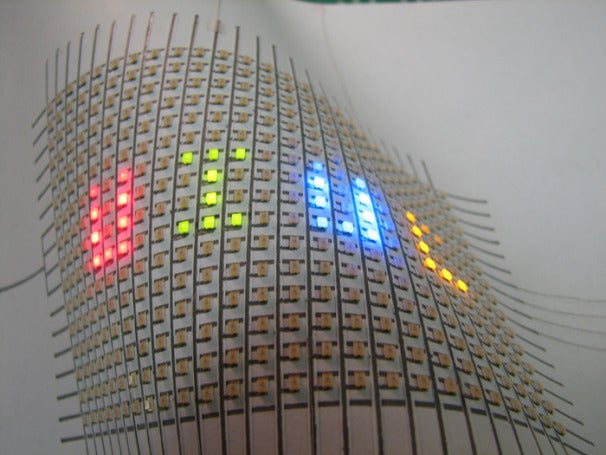
One of the newest researchers at Innovations in International Health @ MIT is Ted Moallem. Ted directs a project called the Blind-Lead Initiative which aims at developing solution for the blind by also enabling them to prototyping their own devices. One of the results looks like this:
What’s more impressing is the amount work the group has done in actually designing a solution that the users themselves can prototype and redesign.
Researchers at the University of Illinois have created a silver-inked rollerball pen to write out electrical circuits.
from Eurekalert:
"The key advantage of the pen is that the costly printers and printheads typically required for inkjet or other printing approaches are replaced with an inexpensive, hand-held writing tool," said Lewis, who is also affiliated with the Beckman Institute for Advanced Science and Technology.
Our group is divided into three main sub-groups with a rich and overlapping set of interests:
(1) Complex Fluids - We investigate the phase behavior, structure, and rheology of colloidal suspensions using a broad array of techniques, including light scattering, rheological measurements, in situ drying stress measurements, and direct visualization approaches, such as confocal microscopy and high speed imaging. Our current focus includes microsphere-nanoparticle mixtures, biphasic colloid mixtures, colloid-filled hydrogels, polyelectrolyte complexes, and photoresponsive colloid systems.
(2) Colloidal Assembly - We employ directed assembly approaches including colloidal epitaxy, evaporative lithography, and microfluidic devices to create precisely patterned colloidal films, granules, and other 3D forms.
(3) Direct Ink Writing - We are designing novel inks for direct-write assembly of planar and 3-D structures with locally tailored composition and architecture. A myriad of ink designs are under development, including colloidal, nanoparticle, fugitive organic, polyelectrolyte and sol-gel inks. Complex 3D structures h ave been produced with minimum feature sizes ranging from ~ 0.2 µm to 300 µm
Sweetening resistance: manuka honey explored as a vehicle to combat antiobotic resistance. Professor Rose Cooper from the University of Wales Institute Cardiff presented her groups findings with streptocicci and pseudomands this Spring.
What’s the best way to get your vaccine on? Spray it according to researchers at Albany Medical College in New York.
PNAS reports on the amazing links between tuberculosis and the fur trade. As if PETA didn’t have enough amunition!
It’s 91 degrees in Managua this Saturday afternoon and we are on the last leg of our train-the-trainer modules for MEDIK. We’ve spent more time abroad the last two months than an MIT. That’s about the change with the start of the semester. This weekend, we’ll be working Ocotal’s district hospital introducing healthcare workers to two new kits: Vital Signs and Prosthetics. [udpate: we just passed an Iguana crossing]
To recap MEDIK—Medical Design and Invention Kits are a series of lab-in-box kits that serve as “Erector sets” for medical devices. Our approach is nurter inventive behavior amongst “McGuyver docs and nurses” working in global health. We already know that they are coming up with ingenious ways around everyday problems.
For Vital Signs, we are going to introduce a series of components that make up an EKG, electronic stethoscope, some dopplers, and simpler point of care vital signs diagnostic such as pulse oximeters. Bear in mind, we’re not just giving them the final devices. We’re providing a toolkit that allows them to build these devices, add things such as telemetry and datalogging, and create interesting modifucations to make them mor rugged, modular, and useful for their settings. It’s giving them the solution space and the exciting part is going to be what they come up with in the next few days.
In the next post, we’ll talk about the Prosthetic Kit. You’ve never seen a fruit picker work like this before…
Researchers at the University of Delaware are helping disabled kids by designing robot transportation for them. Exploring one’s environment is an important part of early development. Disabilities that limit mobility can prevent young children from experiencing this. Typically children are not offered a powered wheelchair until they are five or six years old, but adding intelligent technologies, like those found in the UD1, makes this possible at a much younger age. Proximity sensors all around the drive unit of the robot add obstacle avoidance and ensure safety when used around other children. When confronted with an obstacle the UD1 will stop, or navigate around it. The unit is controlled by a joystick in front of the rider but it can also be overridden remotely by a teacher, parent, or caregiver.
Designer Jihye Lee proposes a different look for blood collection bags featuring a more solid construction, large labeling of blood type, and a look as though it's meant for sale on 5th Avenue.
3D printing has advanced from being a prototyping tool for designers to a manufacturing implement to make a variety of different objects like prosthetics, medical devices and even houses! Excellent article in today's New York Times about the varied applications and players involved in this exciting new arena.
Terrific piece in today's New York Times on a project to assess the impact of roads and traffic on wildlife. Dr. Ron Ringen, a retired veterinarian has been mapping roadkill on a stretch of highway near his home - he photographs the roadkill and uses GPS coordinates to overlay markers on a Google Map thereby generating a visually rich, real-time display. The project is now growing by leaps and bounds and attracting the attention of government regulatory authorities, insurance companies and environmental groups.
Can you imagine if John Snow had this technology in 1854 ...how long would it have taken him to trace cholera to that contaminated pump on Broad Street ...!
MIT News reports on a new Media Lab technology that could revolutionize the way eye tests are done in the developing world.
from the news site:
Now, a team at MIT's Media Lab has come up with a much quicker, simpler and cheaper way to get the same information — a method that is especially suitable for remote, developing-world locations that lack these expensive systems. Two billion people have refractive errors, and according to the World Health Organization, uncorrected refractive errors are the world's second-highest cause of blindness, affecting some 2 percent of the world's population; all these people are potential beneficiaries of the new system. The team is preparing to conduct clinical trials, but preliminary testing with about 20 people, and objective tests using camera lenses, have shown that it can achieve results comparable to the standard aberrometer test.
I think is representative of what is really going to make mobile health tick: mobile medical peripherals. We've seen this concept work before: mobile glucometers, stethoscopes, and telemedical setups like ClickDisgnostics.
MIT News:
The team will be field-testing the device in the Boston area this summer and will later test it in developing countries. The team already has applied for a patent on the system, named NETRA (Near-Eye Tool for Refractive Assessment), and team members won a prize this year in MIT’s annual IDEAS competition — a contest for inventions and business ideas that have a potential to make a significant impact in the developing world — and were finalists in the 2010 student-run MIT $100K Business Plan Competition.
Augment reality could provide field workers with instant information about a site, it's health, and nearby resources. Project Marmota, while not health-centric (yet, we're going to send an email) could very well provide the tools to make it happen.
SciFoo is annual gathering of scientists, technologists, and geeks in general held at Googleplex in Mountain View.
Thursday SciFoo is 24 hours away. Pretrip planning becomes calm excitement as the participant updates grow on the wiki. The list reads like a runway show of scientists and technologists. Bob Langer, Frank Wilczek, Esther Dyson, JaronLanier, Bill Nye.
It’s not a name dropping contest. The list is interrupted by awesome descriptions of new people and ideas that are now on my Must-Meet/Must-See List.
Big Data: Exascale Astronomy
Open-source drug discovery: possible or not?
The Joys and Sorrows of Blogging on a Network
Do We Live in a Multiverse?
What is the minimum publishable unit? And should we start doing it?
Automating Science
Motivating People to Help the World's Poor
Lab Books 2.0
So I plan—the type of planning you'd do at Disney World to make sure you meet your favorite characters. Remember how dad would optimize the schedule to be first in line for Space Mountain and Tomorrowland Transit Authority? That's me scribbling people's bio's and the session suggestions.
We’re not in Florida and it’s not Disney. This is SciFoo at the Googleplex—Space Mountain has the possibility of going to a one of many multiverses according to Alan Guth, and the car designs in Tomorrowland could be explained by evolutionary design instructions presented by Cornell’s Hod Lipson. Instead of Cinderella, we get a Nobel Prize winning physicist, a fossil expert, a baby psychologist, a chemical-informatics-expert-turned-world-economic-data-indexer and a science toy expert. That and a guy who reconstructed Babbage’s Difference Engine.
Out of Legos.
Friday
Nature, Wired, Discover, PNAS, and the Science and Technology Sections of the New York Times have come alive.
Disney World turns into a Black Friday frenzy as folks dash to two-day scheduling board to secure session spot. Here's where I am awed the controlled chaos that the SciFoo team creates: Small details like blocking of certain hours for people arriving late. Printing every single
participate picture on the wall so you can recognize cool people to run into. Generous sources of caffeine. Handing out tiny little red notebooks to write anything, because you are swimming in ideas. Tim O'Reilly's strong suggestion to stay off the computer and focus on the content and face-to-face interaction.
Friday night begins to paint a multicolored picture of the weekend.
References to fire hoses are woefully inadequate. I meet up with Vaughan Bell, a British neuropsychologist working in Colombia, to plan a session “The State of Third World Science”. Logistics in place, we check out the outdoor bar, where I find some doughnuts with Michelle Khine and trade notes on lab-on-a-chip systems made from ShrinkyDinks. Carnegie-Mellon’s Adrien Treuille and I seem to be on someone's favorite invite list–we ran into each other at PCAST three weeks ago. The co-developer of Fold It and I trade ideas on nebulizer flow simulation.
Then I run into Simon Field from SciToys.com. We’ve never met–but we are on each other's list and spend the next couple days brainstorming ideas for my next medical device. Simon gave me a crash course on DIY optics which led to a laser microscope construction with two webcam lenses he gave me. This will come in handy as a class exercise if I write about instant prototyping anytime soon.
Saturday
Speaking of writing, it’s textbooks that have the group at 9 AM on Saturday all excited–the future of textbook that is. After that, I’m about to go to Matt Todd’s talk on Open Science but it's 10 AM and realized that Vaughn and I are up in Beirut (the name of the room) to kick off our discussion on Third World Science and Scientists. What else would you do on a Saturday morning in sunny California.
To find out about the conclusions of our talk click here. After this, it’s decisions decisions decisions so I crashed the lightning talks and pay attention to Three Rules for Mad Scientists (Garrett Lisi), Carl Zimmer's Three Rules to be Understood;
After that, Jonah Lerer describes how to engineer aha moments, I have one of my very own. I run into rapid prototyping guru Hod Lipson from Cornell (Fab@Home). I get a crash course–I get a lot of the these over the weekend— on our RP tech and its future. He went on to host two sessions where he challenged us to describe the killer app for personal fabrication. My money’s diagnostic manufacturing and on-demand drugs for remote regions .
Fabrication, objects, convenience and immediacy took a back seat during a fiery discussion on the Templeton Foundation where I got to meet Dan Barcay of Google and Hal Abelson of MIT–Cambridge geeks tend to gravitate, especially when we can commiserate about the awful weather waiting for us back home. After mentally bracing the upcoming weather we brainstormed on using the new Android Inventor App for interfacing medical technologies in the developing world. Stay tuned for an update from Cambridge on that one.
Back in Cambridge is where you find Derek Lowe, of Vetter Pharmaceuticals who co-presented with Matt Todd on their quest to pursue the first-ever open source drug discovery platform. They are crowdsourcing drug discovery. Everyone can help!
That's in fact the point that Peter Singer is trying to convey when he talks about this book The Life You Can Save and its message about helping the poor through the individual commitments of everyday people.
It's 5 PM and my brain is running faster than I can talk—sentences seem to fade off as constantly get distracted…that’s Tim O’Reilly, wait did that other guy say prototyping structures out of DNA…I want to try Simon’s Air Canon.
I'm next and I’m not going to lie— kind of freaking out because no one voted for my session: DIY Medical Technologies. I'll be happy if 5 people show up–including a friend from MIT. MEDIKit in hand, I find that the room is full, the projector is ready (after some trial and error) and I try my darnedest to focus on being open and candid. We’re not selling research, we’re sharing what’s working and what’s not. This is by far the smartest group of folks I've encountered, let alone present to. They wowed me with their questions, challenge my positions, and played with our gadgets. DIY Medical Tech might make it after all.
As the evening opens up for dinner, I strike to strike a conversation with a bioethicist on the merits of regulatory reform for global health medical devices; schedule prototypes of diagnostics with Hal Abelson, learn about open source microscopy environments from Jason Swedlow.
It's easy, it's friendly and these folks have nothing to prove but everything to share. Disney should learn from Scifoo because for geeks, this is the Magic Kingdom, where we can wish upon a star, or rapid prototype your own.
Wellcome Trust, the group behind artemisinin and human genome sequencing at the Sanger Institute has just bolstered an existing £80 million initiative to support Indian scientists working on medtech. The project's aim is truly enviable: India and the Wellcome Trust are each contributing £22.5 into a fund for product development of healthcare products.
The press release is sparse on operational details, and that’s what we’re watching out for. The memo says that
“to bring together researchers from both the public and private sectors, largely working in India, to develop innovative new devices, diagnostics, medicines and vaccines that will reach the greatest numbers of beneficiaries, without compromising on quality.”
I hope that includes researchers in other countries, and institutions currently working in the area so that our Indian colleagues won’t have to reinvent the wheel and instead open up their initiatives to co-discovery. I also hope that it can lead impact on the ground and in remote areas and not just a gateway for Indian exports to wealthier markets. That model has been done before, and we sincerely need one that addresses patients living in the lowest economic levels of the pyramid.
R&D for Affordable Heatlhcare Initiative
What: Affordable healthcare products for India
Who: Welcomme Trust and DBT Alliance India
Who can play: Anyone operating in India with or with a project in India
I’ve yet to read the book. As a designer a lot of the descriptions on Design Thinking seem to be obvious in what I do. I’m sure there is more it. In the meantime, The New York Times has a short analysis on how Designs Thinking and Six Sigma (I’m not necessarily a fan) can co-exist successfully.
“Design thinkers, he says, are like quantum physicists, able to consider a world in which anything — like traveling at the speed of light — is theoretically possible. But the majority of people, include Six Sigma advocates in most corporations, think more like Newtonian physicists — focused on measurements along three well-defined dimensions.
Analysis of case studies are great, but as SELCO Solar’s Harish Hande says, go out and create your case study. So whether it’s reengineering, agile management, Six Sigma, or Design Thinking, let’s be on the lookout for groups that leave the best model out there—the one that delivers an impact to the customer (or the patient).




 different objects like prosthetics, medical devices and even houses! Excellent article in