Saturday, March 28, 2009

Win $5,000: Designing for Better Health Competition

This is a fantastic opportunity for our readers.

The deadline for submission of entries is April 1, 2009. The three best entries win $5,000 each. For more details on the competition, please visit http://www.changemakers.com/en-us/designingforbetterhealth

Ashoka’s Changemakers and the Robert Wood Johnson Foundation have launched a global search for “nudges” – innovative little pushes that help people make better decisions for their own health and the health of others.


This year, the focus of this open forum competition is health---and there's only 4 Days left to Enter!

Full Disclosure: I am a judge in the competition. And naturally, I've love to see some really good entries.

D-Lab Health @ MIT


We have been incredibly busy this year. Starting today, I'm catching up to share what we've been up to. The blog has never really been about us and I kinda like that. Despite that, let me share...

Announcing D-Lab Health:
Medical Technology for the Developing World

I am teaching a new course we designed over the last few months called D-Lab Health. It's a new offering from the D-Lab family of classes. If you are not familiar with D-Lab then go to their website and catch up on some articles here and here. It's a cluster of MIT's academic offerings for the developing world under the leadership of Amy Smith, Senior Lecturer at the MIT Department of Mechanical Engineering.

The idea is create the next crop of little devices that could so I can blog about them. Maybe I can give the students credit for blogging about them (noted).

All kidding aside, what are aiming to train students to design the next set of medical devices for the developing world. This is what I do for a living at MIT and we thought it would be fantastic to show students who are already interested in appropriate technology how to go through the process as well.

Being a D-Lab class, our aim is to get them to do hands-on work as soon as possible. So we devised a series of training kits that could cycle the students through a series of medical technologies in at pretty good clip. Shown below for instance is the Drug Delivery Kit. Students were able to get acquainted with drug delivery technologies and make complete some initial design excercises.
The complete list of kits includes: Mobile telephony, Surgical instrumentation, diagnostics, microfluidics, imaging, and vital signs. The microfluidics has been incredibly popular for the students. They technology is certainly buzzing around scientific circles and it gives them access to very early stage hardware in which they can contribute their own designs and hacks.

Finally, after 8 weeks of cycling through technology and teaching them our approach to global health technology, we take them to Nicaragua for a week. In fact, they are down there right now and while we intended to have a live-blog going on at http://dlabhealth.blogspot.com/ , I think they have been too busy to be stuck in front of a computer (see Fig 1). The goal of the trip is to be able to spot local innovation, assess local challenge, and create a portfolio of problems by which they can design better device solutions.

More pictures to follow on the trip.

The D-Lab Health students travel back to MIT on Monday and we are very excited to begin Phase II of the class. This will involve applying the D-Lab design process to begin prototypes and understanding the nuances of medical device product development for these countries. We're excited!

For more information go to the D-Lab site.

You can also access to course pages and the entire set of materials in our Stellar page here. MIT is very open about and we are more than happy to contribute. If you have problems accessing anything, just leave a comment below.

Tuesday, February 24, 2009

XoutTB gets colors


XoutTB is a one of the projects underway at the Little Devices That Could Lab at MIT (ok, it's called something else). We have covered the technology in the past when reviewing therapy compliance for both infectious disease and chronic conditions. Technology Review was nice enough to cover the technology again. The story in the March issue also sports a new shot of the latest iteration of the actual diagnostic.

One of new things is a suggestion by Rachel Glennester: colors. Dr. Glennester is the Executive Director fo the Abdul Latif Jameel Poverty Action Lab at MIT. Since there is a specific sequence of diagnostics that the patient has to report, the addition of colors adds another way to randomize the sample and provides some variety to the user.

More at Technology Review

Saturday, January 17, 2009

Spotlight on Brazil's Emerging Biotech Players

A report published last year in Nature Biotechnology points to the healthy growth of Brazilian biotechs against the backdrop of emerging players in India, China and South Africa. 

Of the main author's of the paper, Dr. Peter A. Singer,  states that "One thing is clear: when you think of biotechnology, its no longer just San Francisco, Boston, London and Tokyo. It's also Hyderabad, Shanghai, and Sao Paulo. While in the emerging economies it is still in it's adolescence, biotechnology is no longer the sole hegemony of the rich world. Biotechnology innovation is becoming globalized."

The paper covers 19 case studies of Brazilian-owned private health biotech companies and four public research groups. Unlike it's Indian and Chinese counterparts, the Brazilian case studies point to a focus to find affordable health technology for it's domestic population. While there is still no Pelé for biotech, there's several contenders.

"What you call a neglected disease, I call a business opportunity," said Fernando Kreutz, president of Porto Alegre based FK Biotecnologia. That type of optimism is what is needed to stay ahead of the investment opportunity curve. For Stateside investment firms not paying attention, firms like FK and diagnostics maker Katal Diagnostics, who makes a $25 TB test to replace the $150 version, represent real opportunities where development meets entrepreneurship and results in benefits for all both patients and investors. I don't want to play an armchair investment manager, but it's not hard to conclude that those who react to the current economic climate by circling the wagons and staying within our borders will miss out against those who choose to diversify abroad. 

The paper's press release notes some of the accomplishments of the Brazilian industry:

Notable products in the pipeline of various companies include:
  • several monoclonal antibodies for cancer treatment (Recepta Biopharma, of São Paulo);
  • a recombinant protein for treating melanoma as well as anti-hypertensive and an analgesic peptide – both isolated from snake venom (COINFAR, of São Paulo); and
  • fetal, neonatal and adult stem cell therapies for cardiac disease, type I diabetes and neonatal hypoxia (Cryopraxis, Rio de Janeiro).
as well as some barriers to escalation:
A patent regime in desperate need of reform.
- Seven year wait period for patent processing
- Laws against IP protection of key biotech tools such as recombinant versions of proteins found in nature
- The national regulatory agency's final word on patented pharmaceutical products based on public access

Regulatory issues
- Lack of practical product development and manufacturing experience by regulators
- Long delayed in ethics approvals for clinical trials
- Complex navigation of biosafety and biodiversity rules

Human resources
- University centric academic models of research have yet to effectively transfer human resources specifically tailored to the health biotech sector
- Private enterprise are still working on ways to match career incentives systems currently found in academia and government sponsored research programs

We'll keep an eye of for the South African research paper and try to come up with a nice comparative review for our readers. 

Wednesday, December 24, 2008

Little Social Venture Start-Ups That Could: Day 1

Every day, up to the end of the month, we’ll profile one group that proves that global impact can come in small, energetic packages to help communities around the world.

We’ll kick things off with a veritable engine of developing world research that is igniting scientific exploration among developing world scientists: Seedings Labs.

The Cambridge social enterprise collects laboratory equipment academic and private sector research labs in the U.S., sorts, refurbishes it when necessary, and ships it to scientists who have passed the Seeding Labs selection criteria. Under the leadership of Echoing Green fellow, Nina Dudnick, the group has grown from a student-run outfit at Harvard to an independent technology transfer powerhouse.


Their mission has multiple benefits in different flavors:
  • Greening Science: They are reducing the burden of having to discard surplus laboratory equipment by giving it second tour of duty in labs around the world.

  • Democratizing Research: They are creating a generation of scientists that are home-grown, spurring local and unique research pathways, and opening the science education for students.


  • Reversing the Brain Drain: It’s empowering scientists who would otherwise not go back to their countries after receiving advanced training in the West.


  • Sustaining Discovery and the Next Great Minds Behind Them: This is not your weekend lab garage sale. By mapping their database of emerging research with a real-time inventory system, they can optimize shipments to the best candidates for cutting edge research in far corners of the earth.

How YOU can HELP!
  • Back them with your checkbook. All our featured start-ups have real expenses behind their fantastic stories. Send Seedings Labs some Holiday cheer and when one of their scientists makes Nature, you’ll feel like your own private Wellcome Trust.

  • Sign up to volunteer: If you want to see the operation first hand, contact Seeding Labs for volunteer opportunities. Packing boxes full of PCR machines and flow cytometers will energize the geek inside you on a Saturday morning

  • Spread the Word: Do you work in a lab that has some extra lab equipment looking for a new home? Talk to your boss and show them how Seeding Labs can find a new home in an exotic location. Your corporate social responsibility committee will be the coolest kids in town.
More at Seedings Labs

Tuesday, December 16, 2008

Off-roading to save babies!


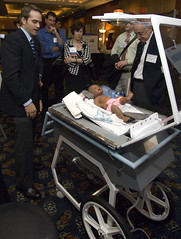
The "car parts incubator", a project of our colleague - Dr. Kris Olson - was featured in the New York Times. Kris was also the subject of a Boston Globe profile describing his other projects. 

This is a neo-natal incubator built entirely from parts scavenged from an automobile. The prototype featured here used parts from a Toyata4Runner.

One of the important learnings here is that the best way to sustainably implement technology-based solutions in the developing world is to include durable mechanisms of distribution and local technical support, very early in the design and development process.   
 

Tuesday, December 9, 2008

Have SMS, Will Operate :)

I thought I had read everything involving mobile phones and global health applications. We've covered cell phones as surgical lights, as health information companions, diagnostic and compliance platforms, etc.

I've never come across the cell phone as a surgical coaching aide. That the experience of Dr. David Nott from Médecins Sans Frontières during a risky life-saving arm amputation of a Congolese boy. Thanks for quick thinking (and thumbs) Dr. Nott received step-by-step instructions from his friend Professor Meirion Thomas back in London via SMS on how to perform a forequarter amputation.

The BBC interviews Dr. Nott:

Hat tip to Medgadget

Monday, December 8, 2008

Swiping for Health: Utah Researchers unveil diagnostic possibilities

Scientists Marc Porter and Michael Granger from the University of Utah have devised a method that takes advantage of a phenomenon known as giant magnetoresistance (GMR) to detect various disease markers. GMR is a Nobel prize winning discovery that has been known for 20 years:
Magnetoresistance is the change in a material's resistance to electrical current when an external magnetic field is applied to the material. That change usually is not more than 1 percent. But some multilayer materials display a change in resistance of as much as 80 percent. That is giant magnetoresistance.

Porter and Granger created a prototype reader that uses this phenomenon to detected changes in GMR caused by the presence of spots along the sensor. By swiping the sensor along the GMR reader, the sequence of spots (arguably the presence of some pathogen) creates a unique signature that gets interpreted as a diagnostic identifier. The device is currently PC sized but the team is working on miniaturizing the components for portability.

This is a pretty interesting approach to diagnostics and I wonder if it offers an alternative to the advances of lap on a chip technology, or if will become another form of diagnostic vacuum tubes.

More at Eureka Alert

Little Devices in the Wind: Part II


Some time ago we featured a series of mini wind turbines by a group of researchers in Hong Kong. A great follow up is the Febot which combines a single AA-battery socket with a mini turbine to make a single charging station that sticks on the side of a window. They should make a version that can stick to your bike handlebars.


More at Yanko Design

Malaria Vaccine Launched

The Bill and Melinda Gates Foundation funded the development of a series of vaccine candidates against Malaria. The results are coming in from Burkina Faso, Gabon, Ghana, Kenya, Malawi, Mozambique, and Tanzania and they show that one candidates to be 30 to 50% effective. That may be a little too low to make a huge impact. The investment seems to be paying off in a step in the right direction though.

More at Foreign Policy

The History and Science of LEDs


The Appropriate technology gurus at AIDG have a wonderful collection of LED videos that shows the history behind the ubiquitous light source, and a series of tutorials on a DIY LED. Sounds like a weekend project.

More at AIDG

Sunday, November 9, 2008

3D Printing from Paper and Glue: The Mcor Matrix 3D printer

File under: Christmas wishlist


According to Engadget, UK company Mcor has cranked out an affordable attempt at 3D printing that uses A4 paper and glue to produce rapid prototypes. I had to read this several times, but they use regular paper which gets cut up into bits and then glued to produce the results above. I'll say this is going to be invaluable for our HLab network real soon. The machines are expected to hit the States in 2009.

Their take:
We wouldn't go so far as to say that 3D printers are growing tired, but we are growing short on patience waiting for a commercial version that the average joe / jane can afford. Thankfully, Mcor is up to the challenge, recently delivering its Matrix to the UK and gearing up to bring it to other parts of the world in 2009. Put simply, this carving creature uses traditional A4 paper and PVA glue to create objects like the ones you see above. Throw in a nice, sharp blade and a little bit of computational prowess, and you've got yourself one wicked 3D printer with running costs "up to 40 times less" than competitors.


Thanks to Engadget

Saturday, November 1, 2008

What we've been up to


We're back everyone. After a long stretch of work that included some exciting and blog worthy moments, I've finally caught up with my RSS reader and Blogger to bring you more consistent posts.

We have been simply too busy to blog, which is a shame, because it's been the "good busy" type of busy. We've been awash with devices and great people who are more interested than ever in the convergence of medical technology and international development. That means more LTDC posts than ever in the coming weeks. While this is certainly not an IIH blog, I might as well explain what IIH (and by extension myself) have been up to.

Last week, CIMIT held their annual Innovation Congress which featured an Exploratorium which prominently featured global health medical technologies by the CIMIT Global Health Initiative spearheaded by Dr. Kris Olson and his crack team of innovation specialists [shown at left demonstrating their car parts incubator], as well as IIH technologies (thanks CIMIT!) working under the same tent (or thatch roof...)

We pulled allnighters trying to get newer prototypes delivered, last minute machining, and 3 am diagnostic reactions to make a good showing at the event. By listening to the crowd, it seems our team achieved that.


The week before CIMIT, we were invited to participate in the last session of MIT's Center for Biomedical Innovation's "Critical Elements of a "Learning Healthcare System" workshop, which featured a poster session on global health. We saw our friends at X Prize, M-Lab (MIT's Mobility Lab which designs mobility solutions for the developing world), the BAMM lab's CD4 microfluidic technology, and the other IIH, Innovators in Health which invented the uBox and uPhone telemedical systems for tuberculosis compliance.

Throughout this time, we were delivered the news that Interamerican Bank for Development is going to support us to bolster our collaboration with our Nicaraguan partners, CIES (Centro de Investigaciones y Estudios de la Salud) and CARE Nicaragua. The support will accelerate our collaboration with this dynamic organizational duo by deploying a set of field ready biomedical learning kits that will allow Nicaraguan innovators to come up with their own medical technology innovations. Check out the Scidev scoop here.

Beyond all this, we owe you updates on Joost Bonsen's Development Ventures and their great line up of startups to tackle the Millenium Challenges, my field notes from the upcoming Duke conference on Bioengineering Global Health, and another round of devices from the CIMIT event.

Sunday, October 19, 2008

Seen and Heard


Another cool conference (or unconference) that I am missing: the first Open Sustainability Network unconference. Appropedia's Lonny Grafman told me about it and I'm sure they've come up with some great stuff over the last two days.

Technology, Health and Development Blog has a great article on the future of M-money.

Wired has a great wiki on how to take microscopic photos using a digital camera.

According to the PSD Blog, Gartner has some ideas on the future of microinsurance, the scheme that aims to create a new insurance segment at affordable prices. We may finally be able to get a reimbursement code for those agricultural prosthetics.

Congrats to Amy Smith on Winning Popular Mechanics Breakthough Award!

Popular Mechanics just awarded MIT's own Amy Smith with a Breakthrough Award for her pioneering work in bringing technology to developing countries.

The Secret Life Bees: Diagnostics


Artist Susana Soares is creating a series of beautiflly crafted chambers that collect air samples, or breath samples. Her BEE'S project builds on bee's acute odor perception.  In my book, these a wonderful example of good elegant design that can have wonderful apps in the developing world. No electronic noses, or fancy micromechanical systems, or complex diagnostic arrays: just a handful of dutiful bees trained to be attracted to something which produces a yes/no response. 

Another company is working on using the bees as portable explosives detectors.

This reminds of a previous project funded by the World Bank to use trained rats to smell and detect TB in samples. I like the Soares approach more though, after all, no one's put a rat on a cereal box design yet.

More at Proto