Showing posts with label economics. Show all posts

Thursday, May 3, 2007

The Hype Cycle

Some devices can over promise, underwhelm, or completely take us by surprise. The Gartner group put together what they call the Hype Cycle.

Some years ago a number of analysts observed there was a pattern of new technology," says Laura Behrens, analyst at Gartner. "Something new would happen, there would be tremendous excitement, followed by disillusionment. Then some of those would eventually become well understood in their markets. "This happened with such regularity that they could do this model."

On a curve of development, the Hype Cycle tries to predict where technologies are heading: into our pockets and living rooms, or into the Betamax graveyard.

It starts with the "technology trigger", where a breakthrough or event generates publicity, exposing the gadget or technology to a wider audience. This is not a Middle Earth battle ground; it is where technology goes to wilt when it fails to deliver its promises. As people start to learn more about the technology, it starts to struggle up the slope of enlightenment. The final stage is the "plateau of productivity" when it becomes mainstream.

So I'm curious to add an LTDC Hype Cycle of our own that try to map where the technologies we so often hear about rest along the curve. To begin:
Biofuels
Solar panels
SMS for health
Micro lending/micro insurance
Telemedical Apps
Wireless for the Last Mile
Drug discovery guided by traditional remedies
and yes, the OLPC

What else?
Does anyone know of a cool Ajax or Flash app where people can mark up our curves?

Friday, April 13, 2007

Tranforming Global Health Recap Recap

The full notes of the TiE Transforming Global Health are now at LTDC Conferences and Lectures. It's much easier to set up a parallel system for lengthy posts than taking up a bunch of space on this one. So here's what you'll see in the expanded version:
  • Dr. Gerald Keusch, Associate Provost for Global Health, talking about new perspectives in tackling Global Health using innovation and political will.
  • MGH's Thomas Burke, MD sharing the wealth of initiatives housed under MGH's Center for Global Health and Disaster Response. Including a project that repurposes an automobile into an isolette for babies (my favorite).
  • Durable and locally manufacturable microfluidic diagnostic devices by the Klapperich Lab at BU.
  • Need to catch up on your C-section skills? Try a few dry runs on a mother-baby simulator by the SIM Group at CIMIT thanks to advanced tissue engineering and software.
  • Zebra Med: An online telemedical consult service that lets doctors volunteer their time and expertise in far away places in as little as 30 minutes at a time
  • A handful of microclinic business models to cover urban, periurban, and rural patients
  • A global pharma-sponsored set of research and aid programs to combat TB, malaria, and leprosy
  • Insightful discussion on the promise of leapfrogging technologies in global health, and attracting young innovators towards to the field.
The full panel included:
Gerald T Keusch, Associate Dean for Global Health, Boston University
Neil Ryder, PhD, Executive Director of Infectious Diseases, Novartis Institutes for BioMedical Research
Thomas Burke, MD, Director, Center for Global Health and Disaster Response, MGH
Alexis Wallace, Executive Director, Medicine in Need
Vikram Sheel Kumar, MD, co-Founder, President and CEO, Dimagi

They were followed by a number of entrepreneurs active in the intersection of health, technology, and BOP opportunities.

Sunday, March 18, 2007

Saturday, February 24, 2007

BusinessWeek features companies that make nice

I meant to write about this earlier. Catch the January 29, 2007 of BusinessWeek. The cover story features socially responsible practices and the companies that embraces them. Among them, Unilever (also featured in in FP here). Their Bangladesh operation sponsors a floating clinic appropriately called the Lifebuoy Friendship Hospital.


It's a great article on corporate social responsibility, doing business in the developing world, and making some money to boot. Read the full text here.

Interesting in the floating hospital? Click here and here.

Bonus points for those who've actually used Lifebuoy soap---very popular in Tegucigalpa. Full disclosure: Unilever is not a sponsor of LTDC. The naming rights to the blog is still open for bids.

Friday, February 2, 2007

Bubblicious: Teen uses BubbleWrap to Enhance the Texture of Prosthetics

Grayson Rosenberg has invented a way new use for Bubble Wrap: a cost effective cosmetic skin covering for prosthetics.

Rosenberger was able to turn a basic artificial leg into a more realistic one using a heat gun to mold Bubble Wrap cushioning around the steel rod of a prosthetic limb to give it muscle-like tone and shape. He said his invention should benefit amputees in Africa who are viewed strangely because they have to "walk around with an open metal rod" as a leg.

I learned two things:
1. There is a BubbleWrap competition for Young Inventors
2. BubbleWrap is trademarked. I think the generic name is "protective packaging".

Naturally, this qualifies as another great Little Device That Could. Rosenberg's background has taken him to missionary trips to Ghana where he gained insight into a way to give amputees some dignity regardless of their country's economic status.

Sunday, January 21, 2007

Howtopedia, technology goodness gone wiki!


This is the first unsolicited email that I've been pleased to get in a long time. In fact, this is really neat.

Think of Instructables meets Hackaday meets Wikipedia within the development context. The very elegant outcome is something called Howtopedia. It's wonderful how-to list arranged in a wiki fashion covering topics that include Healthcare, Energy, Small Business, Food Processing and others.

The email they sent states that Howtopedia is a Swiss non-profit supported by Practical Action (which we covered earlier) and the International Network for Technical Info (INTI). When you look at the site, some of the articles will look familiar if you've checked out Practical Action's technical briefs.

It's community geared and thanks to the wiki metaphor, I can't wait to see what other users contribute. Who knows, I might throw in a recipe or two.

This ties in very well into our previous coverage of open source design initiatives. I hope Howtopedia fares well.

The excerpt below shows a method of refrigeration.


AIDG has lists a similar repository called Appropedia. I'm less familiar with them, but at first glance, Howtopedia seems to have many more articles. They are also available in English, French, and Spanish. Way to go Howtopedia and Practical Action. I'm a fan.

Learn more here.

Sunday, December 24, 2006

Fun with Statistics: Myths about the developing world, by Hans Rosling

With the drama and urgency of a sportscaster, Hans Rosling debunks a few myths about the "developing" world. Rosling is professor of international health at Sweden's world-renowned Karolinska Institute, and founder of Gapminder, a non-profit that brings vital global data to life. (Recorded February 2006 in Monterey, CA. Duration: 20:35) - More TEDTalks at http://www.ted.com

Go play with the tool, it's free! http://www.gapminder.org

Saturday, December 9, 2006

Practical Action


Found this on Thinkcycle (who knew people were still using Thinkcycle!?)

The website reads,
Practical Action was founded in 1966, as ITDG (the Intermediate Technology Development Group), by the radical economist Dr EF Schumacher to prove that his philosophy of 'Small is Beautiful' could bring real and sustainable improvements to people's lives.

They have lots of projects and technologies deployed. No medical devices that I can see, nevertheless, some interesting ones:
The most popular downloads last month:
1. Recycling of plastics
2. Dyeing textiles
3. Papermaking
4. Wind for electricity generation
5. Oil extraction
6. Solar distillation
7. Cashew nut processing
8. Packaging materials
9. Yoghurt
10. Hydraulic ram pumps

Check our their Gravity Ropeway (I heard IDEO had something to do with this)

The image

Two linked trolleys, on pulleys, run on separate 10mm diameter steel wires which are suspended from towers: as the full trolley comes down, pulled by the weight of its load, it pulls the empty one up, ready for the next load. The trolleys' progress is controlled by another, 8mm wire, looped over a flywheel. A wooden drum brake, with bearing and bracket, governs their speed.

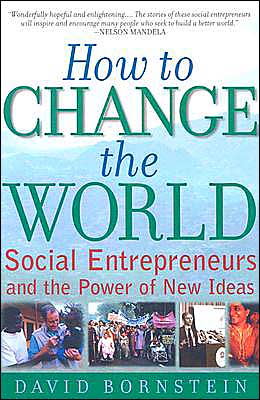
Books: Rx for Survival and How to Change the World


A must read.

Rx for Survival profiles a series of health initiatives around the world, giving upstart social entrepreneurs and innovators opportunities to make a difference. David Bornstein, who previously wrote the story of Grameen Bank, has an excellent volume in How to Change the World. I particularly liked the story of Brazil's Fabio Rosa who introduced monophase electricity in rural areas, standing up against the powerful and centralized lobby of the national electric company who opposed his project.


Friday, December 8, 2006

What's Wrong With Profit?

The NyTimes profiles a series of post-dot com entpreneurs (who did well) including Stephen Case, Jeffrey Skoll and Pierre Omidyar. This isn't all Silicon Valley glitz though, there a number of interesting website and organizations including old (and very succesful groups like the National Geographic Society) and upstarts like Participate.net

Also featured is something called PlayPumps---I'm absolutely fascinated by the idea.

Read the rest of the article


It's also something I saw in the book Gaviotas.

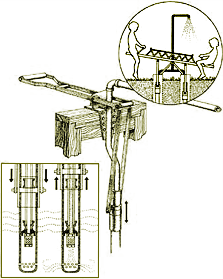
See-saw pump

See-saw pump“In the open-air Gaviotas preschool, the children’s see-saw is actually a pump in disguise. As they rise and descend, water gushes from a vertical pipe into an open cement tank. Over the years Gaviotas technicians have installed these in thousands of school yards, using kid power to provide villages with clean water. This simple, inexpensive pump has revolutionised rural life across Colombia for people who used to haul their water in buckets from muddy tropical rivers.”

Hedge Funds With A Heart

Traditionally known for 30% management fees and the standard 5% cut from profits---hedge funds are Wall Street's current darlings. The Times recently featured Children's Investment Fund, which funnels its profits into social ventures and charity.

Read More