Showing posts with label social entrepreneur. Show all posts

Wednesday, December 24, 2008

Little Social Venture Start-Ups That Could: Day 1

Every day, up to the end of the month, we’ll profile one group that proves that global impact can come in small, energetic packages to help communities around the world.

We’ll kick things off with a veritable engine of developing world research that is igniting scientific exploration among developing world scientists: Seedings Labs.

The Cambridge social enterprise collects laboratory equipment academic and private sector research labs in the U.S., sorts, refurbishes it when necessary, and ships it to scientists who have passed the Seeding Labs selection criteria. Under the leadership of Echoing Green fellow, Nina Dudnick, the group has grown from a student-run outfit at Harvard to an independent technology transfer powerhouse.


Their mission has multiple benefits in different flavors:
  • Greening Science: They are reducing the burden of having to discard surplus laboratory equipment by giving it second tour of duty in labs around the world.

  • Democratizing Research: They are creating a generation of scientists that are home-grown, spurring local and unique research pathways, and opening the science education for students.


  • Reversing the Brain Drain: It’s empowering scientists who would otherwise not go back to their countries after receiving advanced training in the West.


  • Sustaining Discovery and the Next Great Minds Behind Them: This is not your weekend lab garage sale. By mapping their database of emerging research with a real-time inventory system, they can optimize shipments to the best candidates for cutting edge research in far corners of the earth.

How YOU can HELP!
  • Back them with your checkbook. All our featured start-ups have real expenses behind their fantastic stories. Send Seedings Labs some Holiday cheer and when one of their scientists makes Nature, you’ll feel like your own private Wellcome Trust.

  • Sign up to volunteer: If you want to see the operation first hand, contact Seeding Labs for volunteer opportunities. Packing boxes full of PCR machines and flow cytometers will energize the geek inside you on a Saturday morning

  • Spread the Word: Do you work in a lab that has some extra lab equipment looking for a new home? Talk to your boss and show them how Seeding Labs can find a new home in an exotic location. Your corporate social responsibility committee will be the coolest kids in town.
More at Seedings Labs

Monday, March 24, 2008

2008 NCIIA Annual Conference: Wrap up


3 : Hours in the ER before my DC flight due to Aerovax prototype airborne shrapnel landing in my left eye
7:30 : Scheduled departure from Logan to Dallas on Tuesday
5 : Number of liquid crystal displays on the Airtran Embraer Jet taking me to DC connection
1 : Number of check engine lights that rendered the LCDs useless and grounding the flight
2:30 : Arrival time into Dallas the next afternoonDespite the misadventures of travel, I left the 2008 NCIIA Conference wiser and humbled, having met an oustanding group of individuals and institutions working on fascinating products, educational strategies, and global challenges. I'm going to provide some detailed notes at the expanded Conferences and Lectures version of LTDC.

A quick preview:
  • Paul Polack on Design for the Other 90% (it's not just the museum exhibit, it's going to change the face of business and products for folks in emerging markets)
  • Sir Ken Robinson on creativity.
  • The Small Engines group from the Global Innovation Center in Energy, Health and Environment at Colorado State University (guys I need a link here).
  • Baylor University's efforts of transforming coconuts into Home Depot products
More after coffee break (Dallas has a severe deficit of Starbucks, though).

Tuesday, December 4, 2007

LTDC Goes to Graduate School: Harvard-MIT announce HST 939, Designing and Sustaining Technology Innovation for Global Health


Following a long history at MIT of incredible classes like D-Lab, Developmental Entrepreneurship and S-Lab from Sloan School of Management,the joint program in Health and Technology by Harvard and MIT have announced HST 939: Designing and Sustaining Technology Innovation for Global Health. The class will focus on exploring new ways and avenues of answering global health's most vexing problems at the intersection of business, public health, and disruptive technologies. Hands on participation in real life projects with international community and corporate partners will allow students to experience global health development 2.0 from the start.

The class is the brainchild of HST affiliate Jeff Blander, a social entrepeneur and global health expert, who teamed up with Utkan Demirci, a scientist and inventor at Harvard with a shared focus on global health technologies. Your Truly will participate in the design and instruction of the technology and bottom-up innovation aspects of the class. If my posts have been infrequent lately, I apologize, but the there has been a lot of work to set up some exciting projects which I will be sharing with you shortly.

We are continuing to receive a lot of interest from corporate and foundation sponsors about their own projects and the door is open for continuing collaboration. One of the most exciting aspects of the course is its commitment to cross-institutional collaboration. The current partners include companies, NGOs, and other academic institutions beyond Harvard and MIT. So get ready, in a few months, we'll be highlighting the next little devices that could---and the business report cards that go along with them! Everything starts in Spring 2008, but you can submit your projects now!

Friday, April 13, 2007

Tranforming Global Health Recap Recap

The full notes of the TiE Transforming Global Health are now at LTDC Conferences and Lectures. It's much easier to set up a parallel system for lengthy posts than taking up a bunch of space on this one. So here's what you'll see in the expanded version:
  • Dr. Gerald Keusch, Associate Provost for Global Health, talking about new perspectives in tackling Global Health using innovation and political will.
  • MGH's Thomas Burke, MD sharing the wealth of initiatives housed under MGH's Center for Global Health and Disaster Response. Including a project that repurposes an automobile into an isolette for babies (my favorite).
  • Durable and locally manufacturable microfluidic diagnostic devices by the Klapperich Lab at BU.
  • Need to catch up on your C-section skills? Try a few dry runs on a mother-baby simulator by the SIM Group at CIMIT thanks to advanced tissue engineering and software.
  • Zebra Med: An online telemedical consult service that lets doctors volunteer their time and expertise in far away places in as little as 30 minutes at a time
  • A handful of microclinic business models to cover urban, periurban, and rural patients
  • A global pharma-sponsored set of research and aid programs to combat TB, malaria, and leprosy
  • Insightful discussion on the promise of leapfrogging technologies in global health, and attracting young innovators towards to the field.
The full panel included:
Gerald T Keusch, Associate Dean for Global Health, Boston University
Neil Ryder, PhD, Executive Director of Infectious Diseases, Novartis Institutes for BioMedical Research
Thomas Burke, MD, Director, Center for Global Health and Disaster Response, MGH
Alexis Wallace, Executive Director, Medicine in Need
Vikram Sheel Kumar, MD, co-Founder, President and CEO, Dimagi

They were followed by a number of entrepreneurs active in the intersection of health, technology, and BOP opportunities.

Wednesday, March 7, 2007

Young Inventors International

The tinkerers out there will like this post. Innovators, inventors, scientists, thought leaders, business and social entrepreneurs are part of the network and organization known as Young Inventors International. I am rarely a fan of entrepreneurship centers or conferences because they often hype up what is possible into empty motivational talks.

This group is totally different.

Hype and excitement are replaced by thoughtful observation, intelligent feedback, and constant support and education. Just the kind of support you need to look around, plan a strategy and ramp up your project. It's the only support group of its kind that combines entrepreneurship + invention + social return in everything they do.

I can't say enough good things about this invention powerhouse. They offer an array of resources for those of us who are into product development and entrepreneurship. They have real guidance on starting taking your product from idea, to invention, to product, to business. There's no hidden agenda. The non-profit organization's focus is You, Inventor.

This is not your average entrepreneurship center. Anne Swift, the founder of YII, has a talent for finding and connecting people cutting across a wide array of fields. I've met friends working on collaborative software, solar-powered trash compactors, explosive tracking RFIDs, distributed hybrid transportation systems, and portable ice technology (I know ice is portable...you had to be there). I have gotten help from hand picked veteran medical device designers, international technology transfer experts, business people, attorneys...the list is long.

Coming up this month

March 22, 2007 6 PM - 7 PM EST
Intellectual Property Basics Webinar
Suvashis Bhattacharya, Thelen Reid Brown Raysman & Steiner

and you just missed an excellent talk on outsourced manufacturing opportunities.

Tons more info at http://www.younginventorsinternational.com

Sunday, March 4, 2007

Social Enterprise Conference today at HBS


I totally wanted to go this and I totally forgot to register!

Tough week.

Anyways, I know some of you may be going, so take notes, blog, send me your bootleg tapes podcasts, anything...

The schedule seems to be interesting. Speakers include Victoria Hale and David Gergen.

There's going to be a career fair, a Pitch for Change competition, and 18 different panels.

I'm so bummed.

Saturday, March 3, 2007


I recently learned that Aerovax was nominated for this year's Tech Museum Awards in the Health category. Of course, our team is thrilled and humbled that someone out there thinks so highly of our project. Stay tuned and cross your fingers for us! And a big thanks for the person(s) that nominated us!

From their website:
The Tech Museum Awards is an international Awards program that honors innovators from around the world who are applying technology to benefit humanity.

The Tech Awards program inspires global engagement in applying technology to humanity's most pressing problems by recognizing the best of those who are utilizing innovative technology solutions to address the most urgent critical issues facing our planet. People all over the world are profoundly improving the human condition in the areas of education, equality, environment, health, and economic development through the use of technology. It is the goal of The Tech Awards to showcase their compelling stories and reward their brilliant accomplishments.

Each year, candidates are nominated and then invited to submit applications. Individuals, for-profit companies, and not-for-profit organizations are eligible. International panels of judges review the applications and annually select 25 Laureates. Awards are presented in five categories: Health, Education, Environment, Economic Development, and Equality.

More from the Tech Museum Awards site

Saturday, February 24, 2007

2007 MIT IDEAS Competition


The 2007 MIT IDEAS Competition is in full swing. The teams being formed in and around Cambridge, MA include the following:
  • A specially designed training bicycle for mentally disabled people
  • Portable water distiller
  • System of wound care therapy centers
  • Corn flour milling machine for yummy tortillas
  • Electric generator using a specially designed solar concentrator
  • Many more operating under the radar!
The IDEAS competition at MIT brings togethor projects that focus on community and international development questions answered by novel projects backed by technology and invention. Started in 2001, the competition has propelled many projects that have gone on to become sustainable long term endeavors in energy, water sanitation, microfinance, medical devices, agriculture, and information technology.

Friday, February 16, 2007

The Need for Wheelchairs


Recently, a friend emailed me and drew my attention to the pressing need for affordable easy-to-use wheelchairs. I'm including an excerpt of the email and leaving the names out for anonymity:

"One day I was in the office of N, the U.S.-trained engineer who
adapts and fits wheelchairs for the ISIC patients. A woman came in,
pleading with N for a wheelchair for her husband, who was about
to be discharged from the hospital. Her husband had received free
medical care, but there was no money to pay for a wheelchair.
Afterward I discussed the matter with N. Couldn't this man get
one of the very inexpensive wheelchairs that have been developed for
the third world, basically plastic lawn chairs with wheels? No, they
are not suitable, said N; they allow the patients to be pushed
around, but are impossible for a person to push by himself. Besides,
at $40, they are prohibitively expensive. So, I asked, how much would
a good wheelchair cost? Oh it's very expensive, about $120.
Nekram pointed out that the need is very great with thousands of
people in this man's position. But Vicky and I were impressed that so
little money and just a little encouragement could go a long way to
empower these patients."

Needless to say, I started poking around online .. and lo and behold, I discovered the Wheelchair foundation. This organization was started by Ken Behring in June 2000. Wheelchair foundation estimates that there is a need for 100 million wheelchairs, and their near term goal is to get 1 million wheelchairs to people in 5 years. A key observation that I made was that they are able to get a wheelchair that costs $1700 in the US, to someone in a developing country, for about $150. Read more about it here

Saturday, December 9, 2006

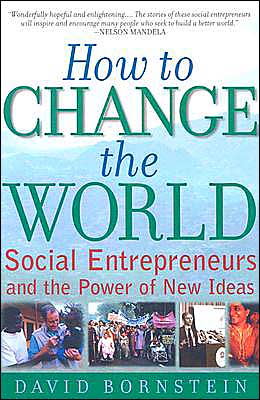
Books: Rx for Survival and How to Change the World


A must read.

Rx for Survival profiles a series of health initiatives around the world, giving upstart social entrepreneurs and innovators opportunities to make a difference. David Bornstein, who previously wrote the story of Grameen Bank, has an excellent volume in How to Change the World. I particularly liked the story of Brazil's Fabio Rosa who introduced monophase electricity in rural areas, standing up against the powerful and centralized lobby of the national electric company who opposed his project.


Friday, December 8, 2006

What's Wrong With Profit?

The NyTimes profiles a series of post-dot com entpreneurs (who did well) including Stephen Case, Jeffrey Skoll and Pierre Omidyar. This isn't all Silicon Valley glitz though, there a number of interesting website and organizations including old (and very succesful groups like the National Geographic Society) and upstarts like Participate.net

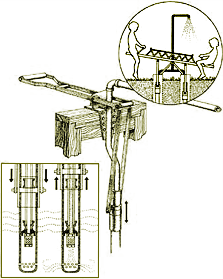
Also featured is something called PlayPumps---I'm absolutely fascinated by the idea.

Read the rest of the article


It's also something I saw in the book Gaviotas.

See-saw pump

See-saw pump“In the open-air Gaviotas preschool, the children’s see-saw is actually a pump in disguise. As they rise and descend, water gushes from a vertical pipe into an open cement tank. Over the years Gaviotas technicians have installed these in thousands of school yards, using kid power to provide villages with clean water. This simple, inexpensive pump has revolutionised rural life across Colombia for people who used to haul their water in buckets from muddy tropical rivers.”